


Would you like to improve the quality, fertility and structure of your soil naturally? Do you want to protect your crops by reducing the risk of disease and pest infestations? Are you looking for solutions that support organic farming?
The answer to each of these needs is basalt rock dust. It is extremely easy to use, environmentally friendly and delivers the maximum benefits for the soil, ultimately improving the quality of your crops.
Find out how you can use basalt rock dust on your crops, what exactly this natural substance consists of and why it is worth using. We have prepared a short guide with the most important information.
Put simply, basalt rock dust is ground natural basalt rock, which forms when volcanic lava solidifies. Its texture resembles a powder similar in appearance to cement. It consists of particles with a diameter of 0.0–400 µm, with 75% made up of the fraction < 100 µm and 65% of the fraction < 75 µm. The composition may vary slightly depending on where the rock comes from.
Why do we use it in agriculture? Because it contains a range of essential minerals and macronutrients that improve soil properties.
The most important component of basalt rock dust is silicon dioxide – around 50% SiO2. But that is not all – ground basalt also contains a range of valuable macronutrients, including phosphorus, potassium, magnesium and calcium, as well as micronutrients such as manganese, zinc, copper, molybdenum, boron, iron and selenium.
This is an important distinguishing feature of basalt rock dust, as these elements are not usually found in standard mineral fertilisers.
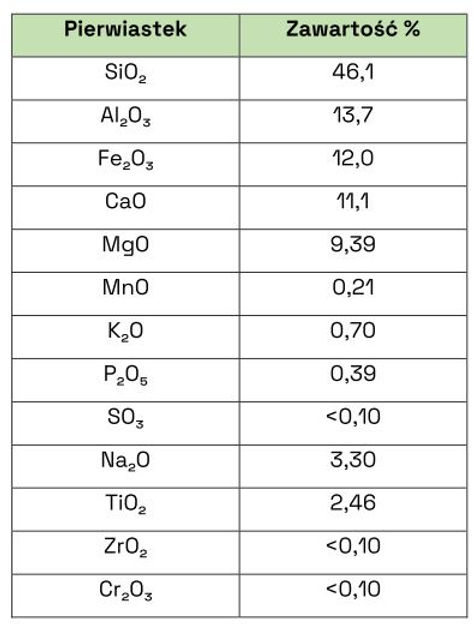
Table: Content (%) of elements in basalt rock dust
What are the benefits of using basalt rock dust on crops? There are quite a few. The rock dust is completely safe for plants and the environment, so it can be used as a fertiliser in organic farming. How exactly does it work? Above all, it increases the mineralogical diversity of the soil. Elements are released from the rock dust most intensively during the first 4 years after application. The slow release of nutrients protects them from excessive dispersion outside the soil–plant system. In addition, basalt rock dust increases the activity of aerobic micro-organisms that process organic matter, supplying the plant with nutrients.
Applying the rock dust reduces soil acidity, limiting the occurrence of mobile forms of aluminium, which inhibit root system development and nutrient uptake.
Regular use raises soil pH, so the crop does not need added calcium fertiliser to maintain fertility. Its structure also helps retain more moisture in the soil, which is extremely important for protecting crops during periodic droughts.
The best results from fertilising soil with basalt rock dust are achieved on depleted soils and soils prone to mineralisation, as well as where there is a high risk of nutrients being dispersed (infiltration with water) beyond the reach of the root system.
Basalt rock dust can be used for:
Basalt rock dust also works well as a supplement to organic fertilisers – manure (1–10 kg/m³), biohumus, slurry and compost (2 kg/m³). It increases their fertiliser value, reducing losses of ammonium nitrogen as ammonia by up to 25%. It makes application easier by reducing dust and neutralises unpleasant odours.
The dose depends primarily on the quality of the soil and the type of crop.
The rock dust can be applied several times a year. To reduce costs, it is recommended to apply it annually (field crops 1–3 t/ha) or in cumulative doses every 3–5 years.
How should it be applied? Basalt rock dust can be mixed into the topsoil before planting. This substrate can also be used to cover plant roots (a method that works well, for example, in tree nurseries) or the beds themselves if the plants are already planted. On larger farms, the rock dust can also be applied:
The speed at which basalt rock dust acts on the soil depends primarily on particle size. The finer the particles, the faster it works. In terms of fertilisation, the finest fractions form material that dissolves quickly in the soil. Larger particles will have a longer-lasting effect. The most effective fraction of basalt rock dust is considered to be particles of 1–80 µm.
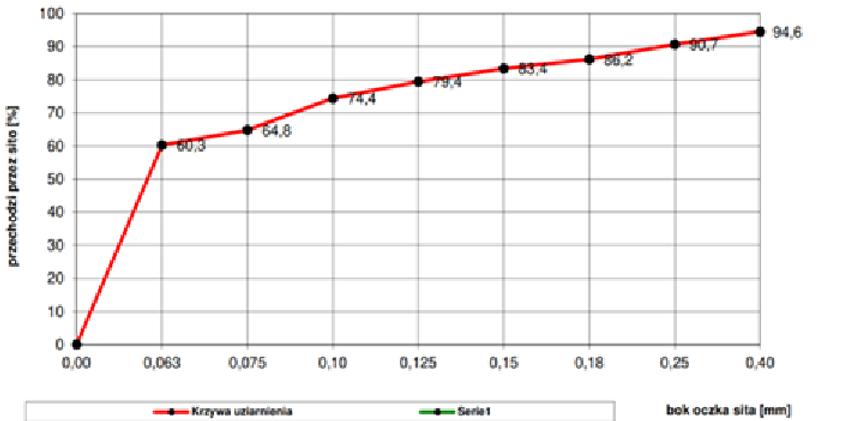
Fig. 1 Particle size distribution curve of fine-grained basalt rock dust 0.0–0.5 mm
At lower soil pH values, dissolution processes are faster due to the effect of soil acidity. Higher temperatures speed up the rate at which minerals dissolve.
The dissolution of basalt rock dust is very strongly influenced by the presence of CO2 in the soil and the pH of the soil solution. Rapid microbial activity increases the rate at which the soil solution is supplied with cations (a source of macro- and micronutrients) and with silicon in the form of orthosilicic acid (H4SiO4).
don't wait, write to us or use the contact form.